Normal Life as a Disguise
The RadleysNormal Life as a Disguise is a recurring motif in which ordinary habits, respectable appearances, and familiar social roles become costumes for concealing what people are or what they have done. The idea connects the Radley family’s urgent attempt to preserve a normal routine after Clara kills Stuart Harper with a broader image of village life as performance. Its central tension is not simply between truth and a lie: the disguise may offer practical protection, but it also makes the hidden truth harder to ignore.
Village and the Costume Image
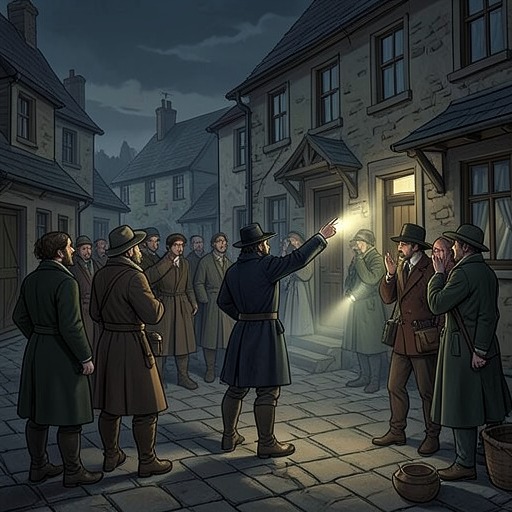
The motif takes its clearest figurative form in Rowan and Clara’s view of their village. Though it presents itself as a quaint English community, they experience it as a “half place,” dependent on buses, internet connections, and other routes of escape. Its collection of businesses reinforces that sense of constructed identity: a refined deli sits beside Fantasy World, a novelty costume shop whose window outfits almost disguise its other trade. In daylight, the village’s shops appear as an eclectic mix that does not quite belong together.
The shop supplies the metaphor, but Rowan and Clara extend it beyond literal clothing. The village, in their account, resembles one large costume store, its residents and institutions clothed in subtler disguises. The image makes normality look less like an unquestioned condition than a role people put on. The village’s familiar appearance can conceal its dependence and fragmentation, just as a costume can make an outward identity look settled. This is not presented as a simple contrast between a false town and a truthful alternative: the pressure to perform belongs to ordinary life itself.
The thought ends in a choice. Anyone who lives in the village long enough must either buy a costume and pretend to like it, or face the truth of who they are. The contrast gives the motif its ethical edge. A disguise can make belonging possible, but adopting it may require someone to participate in a performance that conflicts with self-knowledge. The image therefore speaks both to the town’s social appearance and to the Radleys’ more intimate concealments.
The Abstainer’s Rule
The idea also appears as explicit advice in The Abstainer’s Handbook (second edition). Its instruction is to take pride in behaving like a normal human being: keep daylight hours, hold a regular job, and associate with people who have a fixed sense of right and wrong. Normality here is not just an appearance but a disciplined pattern of conduct. Daylight, work, and company provide a recognizable human routine, one that can make an unusual life legible as ordinary.
Yet the language of acting normal preserves the tension between conduct and identity. The instruction treats normality as something to enact, not proof that a person has become ordinary. In that sense, the handbook’s counsel and the village’s costume image illuminate one another: both present familiar behavior as a form that can be adopted. The advice also gives the performance practical boundaries. Keeping regular hours and mixing with people who hold conventional moral standards means shaping daily life around visible signs of social membership, rather than relying on appearance alone.
The Radleys’ Performance at Home
After Clara kills Stuart Harper, Peter Radley burns his and Clara’s clothes in a roaring fire. The act follows the killing and sits alongside the family’s effort to contain its consequences. The clothes are more than a change of outfit in this sequence: they are material traces of the night, destroyed as the household attempts to regain control. The fire makes the need for concealment concrete, while the family’s next actions turn toward a different kind of covering: the performance of routine.
Peter and Helen Radley tell Rowan the truth, but only half of it, and even that is difficult for him to believe. Rowan’s response names the fact the parents have disclosed: Clara killed Stuart Harper with her teeth. The partial disclosure complicates the boundary between concealment and honesty. The children are no longer being kept wholly outside the truth, yet the family’s account remains incomplete. Normality cannot restore their previous understanding of home; it can only organize what happens next.
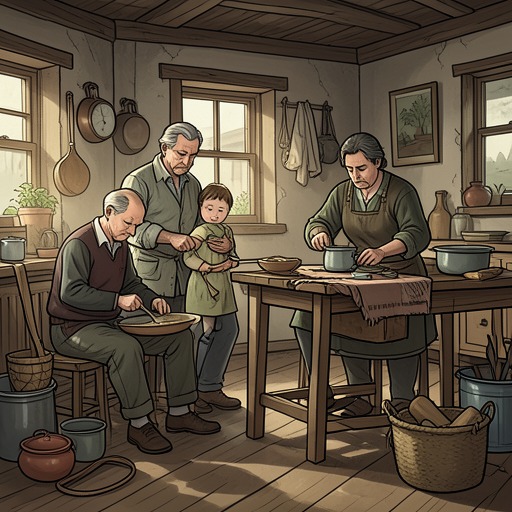
The following morning, Helen makes scrambled eggs because it is Saturday. Rowan sees the baffling gap between the meal and the circumstances surrounding it: a familiar breakfast is being prepared in a house whose occupants are vampires. Peter supports Helen’s argument that, if the family is to get through the crisis safely, they must behave as they normally would. People may talk, and the police may ask questions; at that point, however, the situation is not yet a missing-person case, since twenty-four hours have not passed. The ordinary breakfast is thus both household routine and deliberate strategy.
Secrecy, Safety, and the Limits of Normality
The family’s performance is not portrayed as effortless. Rowan’s bafflement makes the strain visible, while Helen’s insistence that the family continue acting normally supplies its immediate purpose: safety amid the possibility of gossip and police attention. The routine is useful precisely because it is recognizable. Saturday eggs let the household proceed through a familiar ritual while the family manages a crisis that cannot be made ordinary by serving breakfast.
Across these scenes, the motif shifts scale without losing its central contradiction. At the village level, costumes describe the subtle performances through which people inhabit a community and avoid facing what lies beneath its quaint image. In the handbook, ordinary life becomes a prescribed practice. In the Radley home, it becomes an urgent method of protecting the family, accompanied by burned clothes and a truth disclosed only in part. Each instance shows that appearances can offer cover, but none makes the underlying reality disappear. The disguise holds only as a performance, and the effort required to maintain it reveals the truth it is meant to hide.